
I’ve always loved Sir John Betjeman’s poetry. A lot of those in the literature world think he is ‘lightweight’ compared to the likes of TS Eliot (who taught Betjeman at prep school), WH Auden and Philip Larkin (who was a great admirer of Betjeman). I always love the sense of fun in Betjeman’s poems and how he never takes himself too seriously. Well aware of his own failings, he was very loyal to his own friends. He became the first poetry superstar when he became Poet Laureate (he’s still the one most people of a certain age recall) and started producing wonderful television documentaries about the architecture, railways and churches of England. He especially loved Cornwall and had a house in Trebetherick, across the Camel Estuary from Padstow. He died in Cornwall and was buried at St Enodoc’s church.
He was known as ‘the nation’s teddy bear’ as he always came across as loveable with his jolly personality. I recently read AN Wilson’s biography of Betjeman and learned about the troubled personal life he had with his parents (particularly his father), his children (his son became estranged from him) and his two ‘wives’ (he was officially married to Penelope, but spent most of his time living in London with Elizabeth.
The week before my wife and I were going to visit St Enodoc’s, I went to our Sunday Speakeasy (a literary group in Penzance) where I learned from my good friend, Diana Dixon that as a young teenager, she had met Betjeman quite near St Enodoc’s church…I’ll leave the story there. Enjoy the poem
JANUARY AT ST ENODOC, NORTH CORNWALL
For Diana
Could there ever be a more curmudgeonly church?
Hidden away behind Trebetherick’s trees at first
Keeping out a weather-eye for flying golf balls –
St Enodoc’s first line of defence against visitors
(Its hermit founder would surely approve).
Beyond the rise of flapping tussocks,
That relay a frantic semaphore…switching
From green to brown and back in the wind,
I spy the scoliotic spire of this chapel-of-unease
Which curses its discovery and hunkers down
In the hope I might pass it by.

At the corpse-gate, I stroke the coffin bier,
Aware that the smooth grey slate
Was perhaps, the last resting place of John Betjeman
On the Poet Laureate’s final journey.
Standing alone, his stone shuns
The company of others, but positions itself,
In accordance with his wavering belief,
Close enough to the gate…
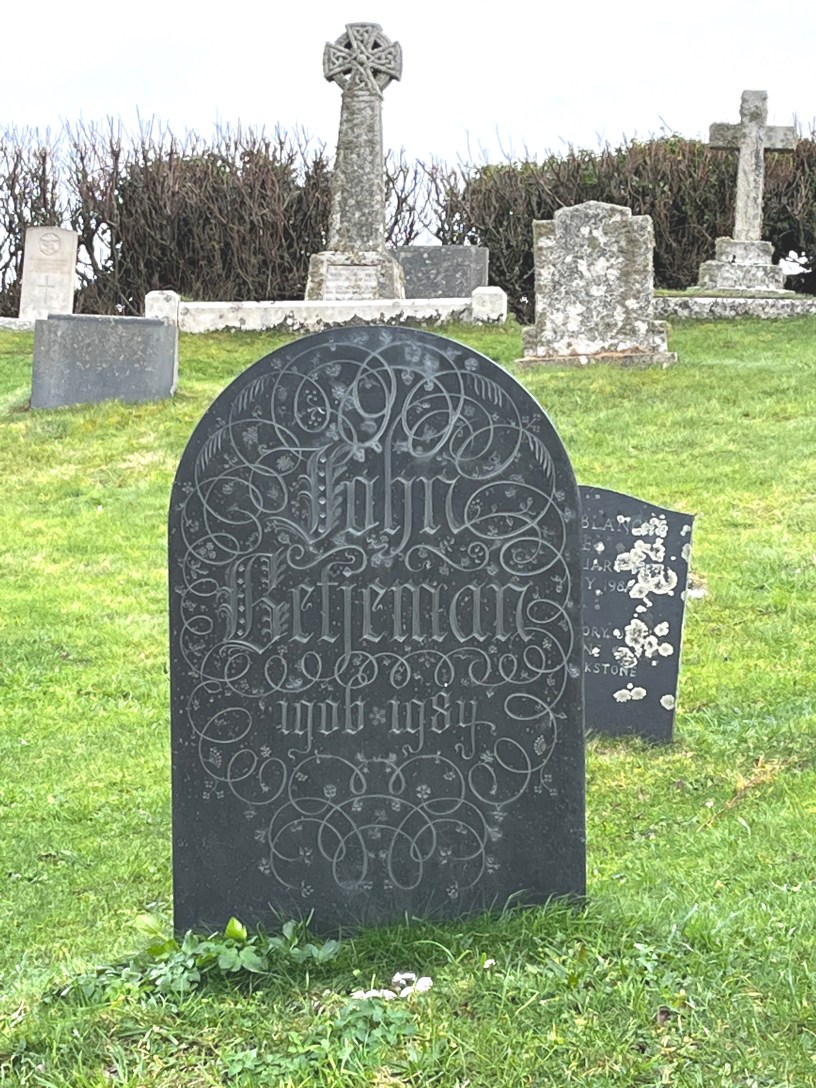
The stone, plain slate from nearby Delabole,
Is inscribed with the superfluity of flourishes
You might find under a child’s first signature;
A doodle for a poet no longer composing…
But the church entrance is welcoming at least
As pine cones and apples tart up the gloomy ingress.
After finding the light switch, I see the interior is spartan;
The walls rendered and white-washed, grey flagged floor.
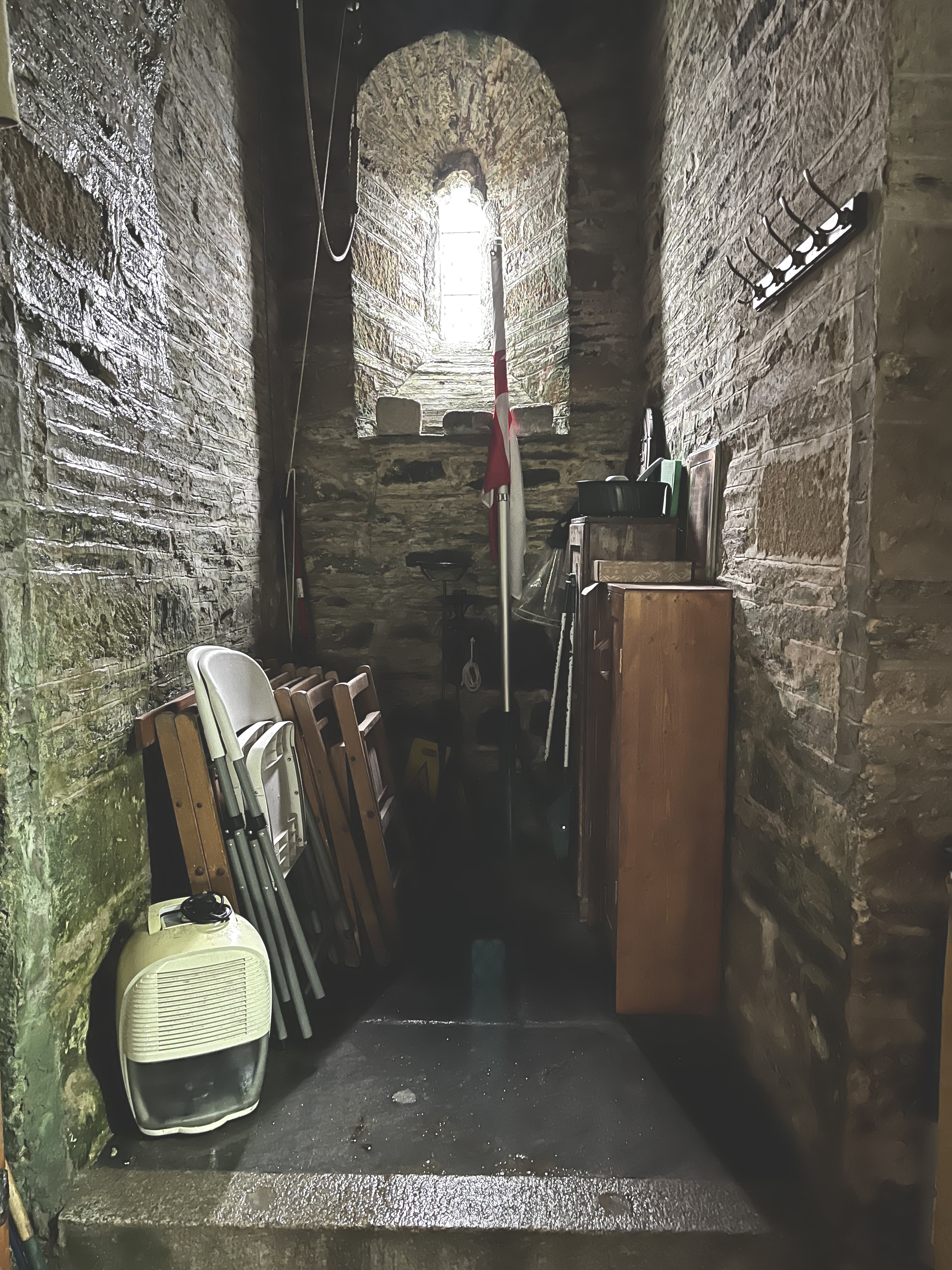
Rainwater drips down from the bell-tower
Splashing coat hooks no one would choose to use,
And limp bell ropes – weary of summoning.
An ageing dehumidifier stopped bothering long ago
And squats disgruntled on the floor.
As I gaze up at the rib-vaulted ceiling
And think of Jonah inside the whale.
Behind me, the poet’s father is immortalised
In a plaque: Ernest Edward Betjemann 1872 to 1934,
The last of three generations of high-class cabinet makers;
He worshipped here and fell out with his only son
Who just wanted to write poems
Their uneasy relationship endured and left
One within the church and one without.

I climb up to the graveyard’s highest point,
And sit on the bench, feeling cold-shouldered,
As there is little in the way of refuge from the westerlies
That surf across the grey Daymer Bay;
Even the protective arm of Brea Hill offers no comfort.
Below me, once buried by wind-blasted sand, the church
Unearthed and as trenched as an archaeological dig,
Sits hunched like a cat in a litter tray;
Hemmed in by five of eighteen holes
Where golfers provide today’s only colour;
Sprays of anemones out of season.
From the bench I gaze down at the tilted gravestones
And imagine my hand flipping them over in turn
As I eliminate each one from a game of Guess Who?
Until I am left with only the ageing curmudgeon.
But it is her story I remember…not his.
The schoolgirl, a summer five decades gone.
A Cornish maid, swinging her Girl Guide hat,
Walks carefree along the compressed dune path.
And sees him shambling along towards her,
Holding down his battered brown trilby
Against the playful incoming zephyrs.
She knows him, though many her age wouldn’t,
But this bright girl has seen him on the telly
The famous poet, the nation’s teddy bear
Composing, no doubt, as he heads in her direction.
She gives him her brightest and best smile
Before calling a cheerful, “Hello, Mr Betjeman!”
He strides past her and without any rhyme or reason
Tells her to “Fuck off!”
©graylightfoot
 gray lightfoot